.svg)

.svg)
It's one of the first things patients ask at Fremont Star Dental: "How long does Invisalign take?" It's a fair question — and the honest answer is that it depends. At our practice, we've treated cases that wrapped in seven months and others that took two years. The range is wide, and it's shaped by factors that are unique to each patient's teeth, bite, and daily habits.
What we can tell you is this: understanding the timeline before you start puts you in a far better position to stay on track and reach your goal. Here's a clear, realistic look at every stage — from your first consultation to your final retainer.
The Invisalign Timeline at a Glance
- How long does Invisalign treatment take? Most cases fall between 6 and 18 months. Complex cases involving significant bite correction may take up to 24 months.
- When will you notice results? Many patients notice visible tooth movement within the first 2–3 months of treatment.
- How long does it take to get used to Invisalign? Most patients adjust within 3–7 days. Speech changes and mild pressure normalize quickly.
- How long does it take for aligners to arrive after your consultation? Typically 2–4 weeks from the time your digital scans are submitted to Align Technology.
- What factors affect treatment time? Case complexity, daily wear compliance, age, oral health, and whether refinement aligners are needed.
- Can treatment finish sooner than expected? Yes — patients who wear aligners consistently for 20–22 hours daily and attend all monitoring appointments tend to complete treatment on or ahead of schedule.
How Long Does Invisalign Treatment Take?
Invisalign treatment is the process of wearing a series of custom-made clear aligner trays that progressively shift teeth toward a planned final position. Each tray is worn for approximately 1–2 weeks before being exchanged for the next in the series.
The total number of trays — and therefore the total treatment duration — is determined by how far each tooth needs to travel and what type of movement is required. Rotation, extrusion, and torque are slower and more demanding movements than simple tipping. Your dentist maps all of this during treatment planning, which is why the estimate you receive at consultation is specific to your case, not a generic average. If you're considering starting treatment, learn more about our Invisalign treatment in Fremont and how a personalized treatment plan is created for your smile.
Average Invisalign Treatment Timeline
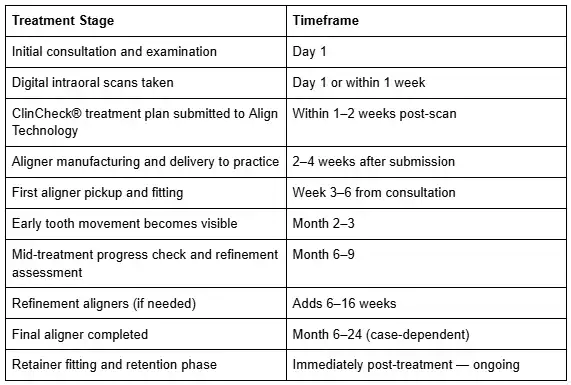
Most straightforward adult cases complete within 12–18 months. Teen cases run at a similar pace. Patients with mild spacing or minor crowding may see treatment conclude well before the 12-month mark. Think of Invisalign like training for a marathon: progress is real and measurable early on, but the finish line rewards consistency every single day — not just at the start.
When Will You Start Seeing Results?
This is the question patients ask most between appointments. The encouraging answer: most patients notice visible movement within 2–3 months. Teeth that are in the most mobile positions — often the front teeth, which have less root surface area and are easier to shift — tend to move first.
By the mid-treatment mark (typically months 6–9), the change is usually noticeable enough that friends and family comment on it. By the final tray set, most patients look in the mirror and see the projected ClinCheck® outcome largely realized.
It's worth noting that how long it takes for Invisalign to work isn't uniform across your mouth. Different teeth move at different rates, which is why treatment planning software sequences the aligner trays carefully — each tray moves the right teeth at the right time.
How Long Does It Take for Invisalign to Work?
Every Invisalign journey follows a different timeline, depending on factors such as the complexity of your case, how consistently you wear your aligners, and your personalized treatment plan. While results don't happen overnight, many patients begin noticing subtle improvements sooner than they expect. Here's what you can typically expect during each stage of the Invisalign process.
The First Few Weeks
Your first set of aligners will feel slightly tight and may cause mild pressure for 1–2 days — this is expected. The pressure signals that the aligner is doing its job: applying controlled force to initiate tooth movement. By the time you swap to your second tray, you'll likely notice the first trays feel noticeably looser than they did on day one. That looseness is evidence of movement.
Speech can feel slightly affected in the first 3–5 days as your tongue adjusts to the new texture in your mouth. Most patients report this resolves on its own as they adapt. We advise patients to read aloud or have conversations normally — the adjustment happens faster than most expect.
The First Few Months
By the end of your second or third aligner set, the routine becomes second nature for most patients. The remove-eat-brush-reinsert habit is well established, and the mild discomfort of new trays shortens with each cycle. You may also start to notice the first signs of tooth repositioning — particularly in areas where crowding was most visible before treatment started.
How long does it take for Invisalign to work in the clinical sense? Movement is occurring from the first tray — even if it isn't visible yet. ClinCheck® plans movement in sub-millimeter increments across each aligner stage. The cumulative effect becomes visible over months, not days.
How Long Does It Take to Get Used to Invisalign?
Treatment compliance refers to how consistently a patient wears their aligners for the recommended duration each day — the standard being 20–22 hours. The adjustment period for new patients typically spans the first 3–7 days.
During those first days, patients commonly notice:
- Mild pressure or tenderness when switching to a new tray
- A slight lisp or difference in speech quality
- Increased saliva production as the mouth adjusts
- Awareness of the trays against the tongue and cheeks
All of these sensations normalize quickly. By the end of week one, the overwhelming majority of our Fremont patients report that they've stopped noticing the aligners except during meal removal and reinsertion. If discomfort persists beyond the first week of a new tray set, contact your provider — it can indicate a seating issue that's easy to resolve early.
How Long Does It Take for Invisalign Aligners to Come In?
After your consultation and digital scans, your treatment plan is submitted to Align Technology's manufacturing facility. Invisalign aligners typically arrive at your dental practice within 2–4 weeks of submission.
During this window, your dentist finalizes your ClinCheck® plan — reviewing the projected movement sequence, confirming attachment placement, and approving the number of aligner stages. Once your aligners arrive, you'll be scheduled for a fitting appointment where your first trays are placed (and attachments bonded, if applicable).
This 2–4 week window is a good time to prepare: stock up on aligner cleaning solution, invest in a reliable travel case, and get comfortable with the remove-eat-brush-reinsert habit before it becomes daily routine.
Factors That Affect Invisalign Treatment Time
No two Invisalign treatments take exactly the same amount of time. The length of your treatment depends on several factors, including the condition of your teeth, your commitment to wearing the aligners as instructed, and how your teeth respond throughout the process. Understanding these factors can help set realistic expectations and keep your treatment on track.
Case Complexity
This is the single biggest variable. Mild spacing or minor crowding — one of the most common presentations we see — can resolve in 6–9 months. Moderate cases with multiple rotated teeth typically require 12–18 months. Complex bite issues like underbites or significant crowding across the full arch may extend to 18–24 months, particularly when bite correction mechanics are part of the plan.
Wearing Aligners Consistently
This is the factor most within a patient's control — and the one that most frequently affects treatment duration. The American Association of Orthodontists (AAO) is clear that orthodontic treatment outcomes depend on compliance with prescribed wear protocols. Removing aligners for meals and cleaning is the intent; removing them for social convenience, comfort, or habit erodes treatment progress.
Patients who consistently hit 20–22 hours of daily wear tend to complete treatment on or ahead of schedule. Those who average 14–16 hours per day often find their treatment extended by weeks or months — sometimes significantly. We track this honestly with our Fremont patients from the start: the aligners only work when they're in.
Age and Oral Health
Adult teeth generally move at a similar rate to teenage teeth — the biological mechanism is the same. However, adults with a history of gum disease, bone loss, or significant dental restorations may require preliminary treatment before Invisalign begins, which adds time to the overall journey. Gum disease screening is standard at our practice before any orthodontic treatment starts. Discover more about how Invisalign works for adults of all ages.
Refinements
Refinement aligners are an additional series of trays prescribed when the original aligner sequence has been completed but the final planned position hasn't been fully achieved. This is normal and common — the American Dental Association (ADA) recognizes that tooth movement is a biological process that doesn't always track to a digital model with perfect precision.
Refinements typically add 6–16 weeks to treatment. They are not a failure of treatment — they're a corrective tool built into the Invisalign process. Many patients require at least one refinement stage, particularly in cases with significant movement requirements. Your dentist will assess whether refinements are needed at the mid-to-late stages of your original plan.
Tips to Stay on Schedule With Invisalign
Staying on pace means finishing on time — or earlier. The habits that matter most:
- Wear your aligners 20–22 hours daily — without exception. Meals and cleaning account for the remaining 2–4 hours. Everything else is optional time you're borrowing from your treatment.
- Switch trays on schedule. Some patients switch every 7 days (as some newer protocols allow), others every 14. Follow your provider's specific guidance — don't delay switches to "bank" wear time.
- Attend every monitoring appointment. Check-in appointments every 6–8 weeks allow your dentist to assess tracking, identify any movement issues early, and order refinements before small deviations become large setbacks.
- Use your chewies. Small silicone cylinders called "chewies" help seat aligners fully — particularly important in the first day or two of a new tray. Poor seating = poor force delivery = slower movement.
- Protect your aligners. Use a case every time trays are removed. Heat distorts the plastic — avoid leaving them in a car, near a dishwasher, or in direct sunlight. A distorted aligner cannot apply the correct force.
- Address any oral health issues promptly. A cavity that develops mid-treatment can pause Invisalign while it's treated. Staying on top of regular preventive dental care protects your timeline.
After your last tray, the work doesn't stop — it shifts. Your retainer after Invisalign is what preserves everything you've worked for. Retention is lifelong, and skipping it is the most common reason patients see their results shift over time.
How long does Invisalign take? For most patients, between 6 and 18 months — with the exact duration shaped by how complex your case is, how consistently you wear your aligners, and how your teeth respond to treatment. Simple cases can finish well under a year. Complex bite corrections may approach two years. The earlier you start and the more diligently you follow your plan, the sooner you reach your result.
The most valuable thing you can do right now is get a personalized timeline — one based on your specific teeth, not a general estimate from the internet. Schedule a free Invisalign consultation at Fremont Star Dental and we'll give you a clear picture of what your treatment would involve, how long it would take, and what you can realistically expect to see at every stage along the way.
Frequently Asked Questions on Invisalign Treatment Time
How long does Invisalign take?
The average treatment lasts between 12 and 18 months, while minor corrections can take as little as 6 months. However, the exact duration depends entirely on the complexity of your specific case, your individual bone density, and your daily compliance. Your provider will map out a customized sequence of clear trays to give you a definitive timeline during your initial digital scan consultation.
Does Invisalign hurt?
You may experience mild pressure when switching aligners, but it usually subsides within a few days. This dull ache is completely normal and simply indicates that the trays are successfully exerting the necessary forces to move your teeth. Compared to traditional metal brackets, clear aligners cause significantly less irritation to your sensitive cheeks and gums.
Can I eat normally with Invisalign?
Yes, you can eat freely once the aligners are removed, meaning you don't have to give up crunchy or sticky foods. Just remember to brush and floss your teeth thoroughly before reinserting them to prevent trapping food particles against your enamel. Keeping your teeth clean before putting the trays back in is essential for preventing cavities and maintaining fresh breath.
How often will I visit the dentist?
You will need check-ups every 6 to 8 weeks so your doctor can monitor your progress and hand over your next batches of custom aligner trays. These routine visits are typically brief and non-invasive, focusing on ensuring your teeth are tracking perfectly according to the 3D digital plan. In some modern practices, virtual check-ins may even stretch these in-person appointments further apart.
Can older adults get Invisalign?
Yes, adults of all ages can benefit if their teeth and gums are healthy, as bone remodeling can happen at any stage of life. In fact, a vast percentage of clear aligner patients are adults seeking to correct minor shifting that occurred years after childhood braces. As long as you have strong bone support and no active periodontal disease, you are a great candidate.
What happens if I don’t wear my Invisalign aligners enough?
If you do not wear your aligners for the recommended 20–22 hours per day, your teeth may not shift as planned. This lack of continuous pressure can cause your progress to stall, forcing your teeth to drift backward and fall out of sync with the trays. Ultimately, poor wear time delays your treatment progress, requires expensive additional aligners, or even compromises final results.
Will I need to wear a retainer after Invisalign treatment?
Yes, after completing Invisalign treatment, wearing a retainer is essential to maintain your new tooth alignment. Because bone tissue takes time to fully solidify around your new root positions, teeth naturally tend to shift back toward their old spaces over time. Your dentist will recommend a personalized retention schedule, usually starting with full-time wear before transitioning to nights only.
Can Invisalign fix severe orthodontic problems?
Invisalign can successfully treat many mild to moderate orthodontic issues, including crowding, spacing, and some bite problems. However, severe or highly complex structural anomalies—especially those stemming from genetic skeletal jaw mismatches—may still require traditional braces. A professional consultation featuring comprehensive panoramic X-rays is the only way to determine the absolute best treatment option for your smile.